
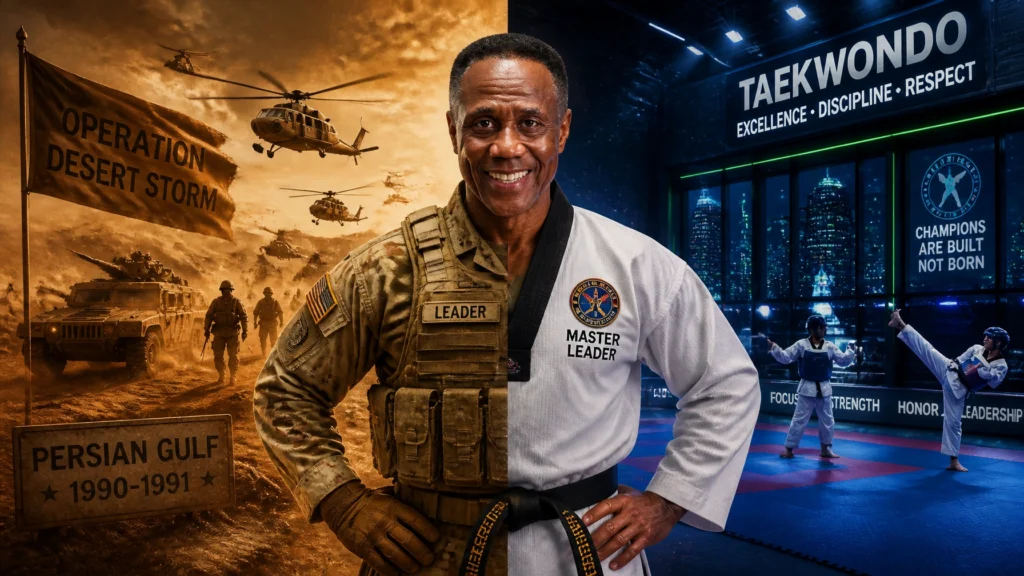
When people think of military leadership, they often picture strategic maps, high-stakes communication, and the unwavering discipline required to lead under fire. They don’t usually jump straight to the high-kicking, fast-paced world of sport karate. But for Dexter V. Kennedy, these two worlds aren’t just connected: they are the same.
Before he became the visionary behind the National Martial Arts League (NMAL), Dexter was a Chief Warrant Officer 2 (CW2) in the U.S. Army, serving during the intense heat and high-stakes environment of Desert Storm. It was in the sands of the Middle East that the blueprint for a martial arts revolution was truly born.
Transitioning from the military to the civilian world is a challenge many veterans face, but Dexter didn’t just want to "fit back in." He wanted to bring the standardized excellence of the Army to the sport he loved. What he found upon his return, however, was a martial arts landscape that had lost its edge: a "watered down" tournament scene that lacked the professional structure and prestige it deserved.
This is the story of how a retired Army Warrant Officer traded his uniform for a gi, using military discipline to build a martial arts empire that is now poised to take on the biggest professional sports leagues in the world.
The Crucible: Leadership in Desert Storm
The military doesn't just teach you how to follow orders; it teaches you how to create systems that survive chaos. As an Army Warrant Officer, Dexter V. Kennedy was a technical expert and a leader tasked with ensuring that complex operations ran with surgical precision.
Desert Storm was a defining moment. In the theater of war, there is no room for "good enough." You either have a standard and you meet it, or the mission fails. This mindset: this absolute dedication to standardization and excellence: became the foundation for everything Dexter would do later in life.
When you spend years in an environment where leadership is about accountability and every moving part has a purpose, you start to see the world through a lens of efficiency. When Dexter retired and returned his focus to his lifelong passion for martial arts, he didn't see a flourishing industry; he saw a missed opportunity.

The "Watered Down" Reality of the Tournament Scene
Dexter’s journey in martial arts began long before his military service, starting in 1986 when he opened his first karate school. Influenced by the philosophy of Bruce Lee, he had always viewed martial arts as a path to personal mastery. But after his time in the Army, looking at the competitive scene felt like watching a masterpiece slowly fade into nostalgia.
The traditional tournament systems were, in a word, fragmented. There was no unifying structure, no professional path for athletes, and often, no standard for what constituted a "world-class" event. To a man who had lived by the strict protocols of the U.S. Army, the lack of professionalization in sport karate was glaring.
"It felt watered down," Dexter often reflects. The passion was there, the athletes were world-class, but the platform was stagnant. Martial artists were pouring their lives into their craft, yet they weren't receiving the same recognition or financial opportunities as athletes in the NFL, NBA, or MLB.
Dexter realized that if martial arts were going to survive and thrive in the modern era, they needed more than just better fighters. They needed a professional league structure that rewarded excellence and created a sustainable future for the sport.
Applying the Military Blueprint: The Birth of the NMAL
How do you take a fragmented sport and turn it into a professional empire? You apply military logistics.
Dexter’s vision for the National Martial Arts League (NMAL) wasn't just about organizing a few more tournaments. It was about creating a city-based professional team league: the first of its kind in U.S. history.
In the Army, everything is standardized. From the way gear is maintained to the way communication flows through the chain of command, standards ensure that whether you are in Georgia or Germany, the mission is executed the same way. Dexter took this concept and applied it to martial arts competition.
The NMAL blueprint focuses on:
- Professionalization: Moving away from the "open tournament" model and toward a professional team structure.
- Standardization: Creating a universal ruleset and scoring system that fans can easily follow and athletes can train for with precision.
- City-Based Rivalries: Following the successful model of the NFL and NBA, the NMAL creates local pride by having teams represent specific cities.

This wasn't just a dream; it was a strategic operation. By creating city-based franchises, Dexter opened the door for investors and entrepreneurs to take ownership of a new frontier in sports.
Bridging the Gap: Innovation and Team Point Fighting
One of the key innovations Dexter introduced was the focus on Team Point Fighting. While individual competition has its place, team-based sports are what drive massive fan engagement and media deals.
In his groundbreaking work, Dexter explores what makes team point fighting different from traditional models. It’s faster, more strategic, and: most importantly: it’s a better product for television and live audiences. By focusing on the "Pro Teams KumiteSport" model, Dexter has created a high-energy environment that mimics the intensity of a playoff game in any major sport.

This shift isn't just about the entertainment value. It's about the athletes. In a team structure, martial artists have access to coaching, medical staff, and a professional salary: things that were almost unheard of in the traditional tournament scene. This is the "standardized excellence" Dexter brought back from his military days.
The Literary Legacy: Writing the Future
Dexter V. Kennedy isn't just a founder; he’s an author and a thought leader. He knew that to change an entire industry, he had to provide the "manual" for how to do it. His books serve as the tactical guides for this new era of martial arts.
From the Team Point Fighting Investors Game Plan to his insights on whether you can truly learn martial arts from a book, Dexter’s writing bridges the gap between old-school discipline and new-school business.
His most significant contribution to the field is the book "Team Point Fighting in a Professional Martial Arts League." In it, he lays out the entire vision: from the technical breakdown of the sport to the business logic of taking on the NFL. It’s not just a book for martial artists; it’s a manifesto for sports innovators.

Recognition and the Road Ahead
The industry has taken notice. On July 16, 2022, Dexter was awarded the Silver Life Award and inducted into the United States Martial Arts Hall of Fame. This recognition from the IMAC Ambassadors Council and Board of Directors wasn't just for his skill as a 5th Degree Black Belt in American Karate (Ishinryu); it was for his leadership in professionalizing the sport.

Today, Dexter continues to build. The NMAL is moving forward with a vision of 32 franchise teams, bringing professional martial arts to arenas across the country. Whether he is consulting with potential team owners or writing his next book, the mission remains the same: to ensure that the discipline, respect, and empowerment of martial arts are given the professional platform they deserve.
Join the Revolution
The transition from the sands of Desert Storm to the mats of the dojang was more than a career change: it was a mission. Dexter V. Kennedy has proven that with enough discipline, standardization, and visionary leadership, you can take a "watered down" industry and turn it into an empire.
Are you ready to see the future of sports? Whether you are a martial artist, a sports fan, or an investor looking for the next big thing, the blueprint is ready.
Read the full story and the vision in "Team Point Fighting in a Professional Martial Arts League" at dextervkennedy.com.
The era of professional martial arts is here. It’s time to take your place in the league.


