
Let’s be real for a second: if you’ve ever hosted a martial arts tournament, you’ve probably aged about five years in a single weekend. Between the parents complaining about the "bad call" in Ring 4 and the hunt for that one judge who wandered off for a hot dog, it’s a miracle the event finishes before the sun goes down.
But here’s the kicker: after all that stress, the "profit" often barely covers the cost of the trophies.
If you feel like you’re running on a treadmill that’s slowly increasing its incline, you aren’t alone. Most martial arts events are stuck in a 1980s business model that refuses to scale. They are local, fragmented, and logistically prehistoric.
The good news? There’s a blueprint to fix this. It’s the Professional Martial Arts League model, and it’s the exact system laid out in the book Pro Teams KumiteSport.
Here are 10 reasons your events aren’t scaling and how the league model turns that local tournament into a national powerhouse.
1. The "Registration Fee" Trap
Most promoters rely 100% on registration fees from competitors. This means your revenue is capped by how many mats you can fit in a gym. If you want to double your money, you have to double the number of kids: which doubles the chaos.
The League Fix: In a professional league, registration fees are just the appetizer. The real money is in media rights and sponsorship. When you move to a league model, you aren't selling mat space; you’re selling a broadcast product.
2. The Logistics Nightmare (The Clipboard Era)
If your primary tool for event management is a stack of paper and a megaphone, you aren't scaling. Traditional tournaments are logistical black holes where information moves at the speed of a tired volunteer.

The League Fix: Standardized operations. A league operates with a centralized "hub" mentality. We’re talking digital brackets, live-streaming integration, and a production crew that knows exactly what happens at 2:05 PM. Efficiency is the parent of scale.
3. Zero Fan Connection (Who Are These People?)
At a traditional tournament, the only people watching are the parents. Why? Because there’s no narrative. There’s no "team" to root for unless you’re literally related to the person on the mat.
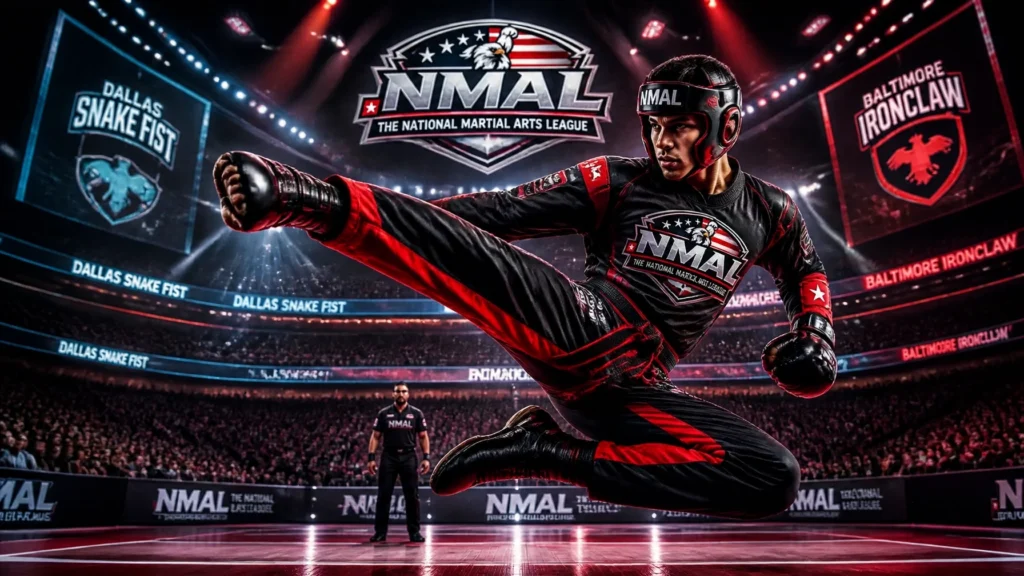
The League Fix: City-based franchises. People in Dallas will cheer for the "Dallas Snake Fist Clan" just because they’re from Dallas. By introducing city-based professional teams, you create instant, built-in fanbases that extend far beyond the competitor’s immediate family.
4. The "Ruleset Roulette"
Every tournament seems to have a different interpretation of the rules. "In this circuit, a spin-kick is 3 points, but only if you land with your left foot while the moon is in gibbous." This inconsistency kills the chance of a casual viewer ever understanding: or caring: about the sport.
The League Fix: Standardized, professional rules designed for TV. The League model uses a consistent ruleset across every franchise. This makes the sport readable, repeatable, and ready for prime time.
5. No Star Power
In the current model, the "stars" change every weekend. There’s no continuity. If a great fighter wins today, you might not see them again for six months. Without stars, you have no marketing leverage.

The League Fix: Contracted athletes and season-long narratives. When fans can follow a fighter’s journey from the season opener to the championship, you build brand equity. You aren't just watching a match; you’re watching a career.
6. Media Blind Spots
If the only footage of your event is a shaky iPhone video from a parent in row 12, you don’t have a media product. You have a home movie. Traditional events ignore the "broadcast" value because they’re too busy fixing the PA system.
The League Fix: Integrated media rights. A professional league is built from the ground up to be filmed. This means professional lighting, multiple camera angles, and commentators who actually know how to call a play-by-play. This is how you attract the big-ticket sponsors.
7. Promoters Have No Equity
Most promoters are only as good as their next event. If they stop hosting, the business stops existing. There’s nothing to sell, nothing to pass down, and nothing that grows in value over time.
The League Fix: Franchise rights. In the National Martial Arts League (NMAL) model, you aren't just a promoter; you’re a Team Owner. A franchise is an asset that appreciates. Just look at the NFL: teams are worth billions because the league structure creates scarcity and value. You can learn more about this in the Team Point Fighting Investors Game Plan.
8. The "10-Ring" Distraction
Walking into a traditional tournament is like walking into a swarm of bees. Ten rings are going at once, whistles are blowing, and it’s impossible to focus. It’s sensory overload for the fan.
The League Fix: The "Center Stage" concept. One match. One focus. High stakes. By narrowing the focus to a single high-production mat, you elevate the perceived value of the fight.

9. The Sponsorship Glass Ceiling
Local pizza shops are great, but they aren't going to fund a national expansion. Big-name brands (think Nike, Gatorade, Red Bull) won't touch martial arts events because they are too fragmented and unprofessional.
The League Fix: Scalable sponsorship packages. Brands want to buy into a "League," not a "Saturday tournament." A league offers them exposure across multiple cities, multiple broadcasts, and a consistent demographic.
10. The Promoter Bottleneck
In the traditional model, the promoter is the CEO, the janitor, the head ref, and the marketing director. You can’t scale a business when the founder is the one taped to the floor fixing the mats.
The League Fix: A blueprint for delegation. The league model provides the infrastructure, so the "owner" focuses on growth while the "system" handles the sweat.
The Blueprint for Change
The martial arts industry is at a crossroads. We can keep doing the same "gym-to-gym" hustle, or we can look at the massive success of the NFL, NBA, and UFC and say, "Why not us?"
The Professional Martial Arts League model isn't just a dream; it’s a documented strategy. If you’re tired of the "One and Done" tournament life and you’re ready to build something that actually scales, you need to read Pro Teams KumiteSport.

Whether you’re a school owner looking to elevate your students, a promoter looking for a better business model, or an investor looking for the "Next Big Thing" in sports, the answer is in the league.
Stop hosting events. Start building a legacy.
- Ready to dive in? Grab a free chapter here.
- Want the full blueprint? Check out the books page or find us on Amazon.
- The Future is Team-Based. See how it works at DexterVKennedy.com.


