
For the modern entrepreneur, the quest for the "next big thing" often leads to crowded rooms and saturated markets. In the world of sports, we’ve seen the meteoric rise of the UFC and the professionalization of everything from cornhole to pickleball. But there is a massive, untapped territory hiding in plain sight: Professional Point Martial Arts.
While the martial arts industry has traditionally been built on the backs of local mom-and-pop schools, a new paradigm is emerging. Spearheaded by visionaries like Dexter V. Kennedy, the transition from local instruction to professional city-based leagues is creating a "Blue Ocean" of opportunity for investors and business owners alike.
If you are looking for a business move that combines scalability, community impact, and first-mover advantage, here are five things you should know about the future of professional combat sports.
1. It is a Classic "Blue Ocean" Market
In business strategy, a "Blue Ocean" is an uncontested market space where competition is irrelevant because the rules of the game are waiting to be set. Professional point martial arts is precisely that.
While Mixed Martial Arts (MMA) has become a "Red Ocean" of intense competition and high entry barriers, point martial arts: the fast-paced, technical, and highly athletic discipline practiced by millions: has lacked a professionalized, national structure. For decades, the talent has existed, but the business framework has not.
The National Martial Arts League (NMAL) is changing this. By creating a professional league that mirrors the structure of the NFL or NBA, the NMAL is carving out a new category. For an entrepreneur, this means you aren’t fighting for a slice of an existing pie; you are helping to bake a new one. This is about capturing the interest of the millions of martial artists who currently have no professional path to follow, and the fans who crave high-speed, technical competition without the extreme violence of cage fighting.

2. The Team Model Offers Superior Scalability
Traditionally, the martial arts business has been synonymous with the "school model." An instructor rents a space, teaches classes, and collects tuition. While profitable, this model has a hard ceiling: it is limited by the instructor's time, the square footage of the facility, and the local population.
The team model flips this on its head. When you shift from a school to a professional team franchise, your revenue streams multiply. You are no longer just selling "hours of instruction"; you are selling:
- Media Rights and Content: Capturing the action for a global digital audience.
- Sponsorships: Connecting local and national brands with a dedicated fan base.
- Merchandising: Selling team-branded apparel that fans wear with pride.
- Ticket Sales: Transforming the sport into a spectator event.
The scalability of a team in a 32-city league is exponentially higher than a standalone school. It allows a business owner to step away from the mat and into the owner's box, managing a sports asset rather than a service business.
3. City-Based Identity Drives Fan Loyalty
One of the most powerful forces in sports is "tribalism": the deep, emotional connection fans feel for their city’s team. Whether it’s the Dallas Cowboys or the New York Yankees, people root for their city.
The innovation of the NMAL lies in its city-based structure. By establishing teams like the "Dallas Snake Fist Clan" or the "Houston 7 Clans of Kung Fu," the league taps into existing regional rivalries.

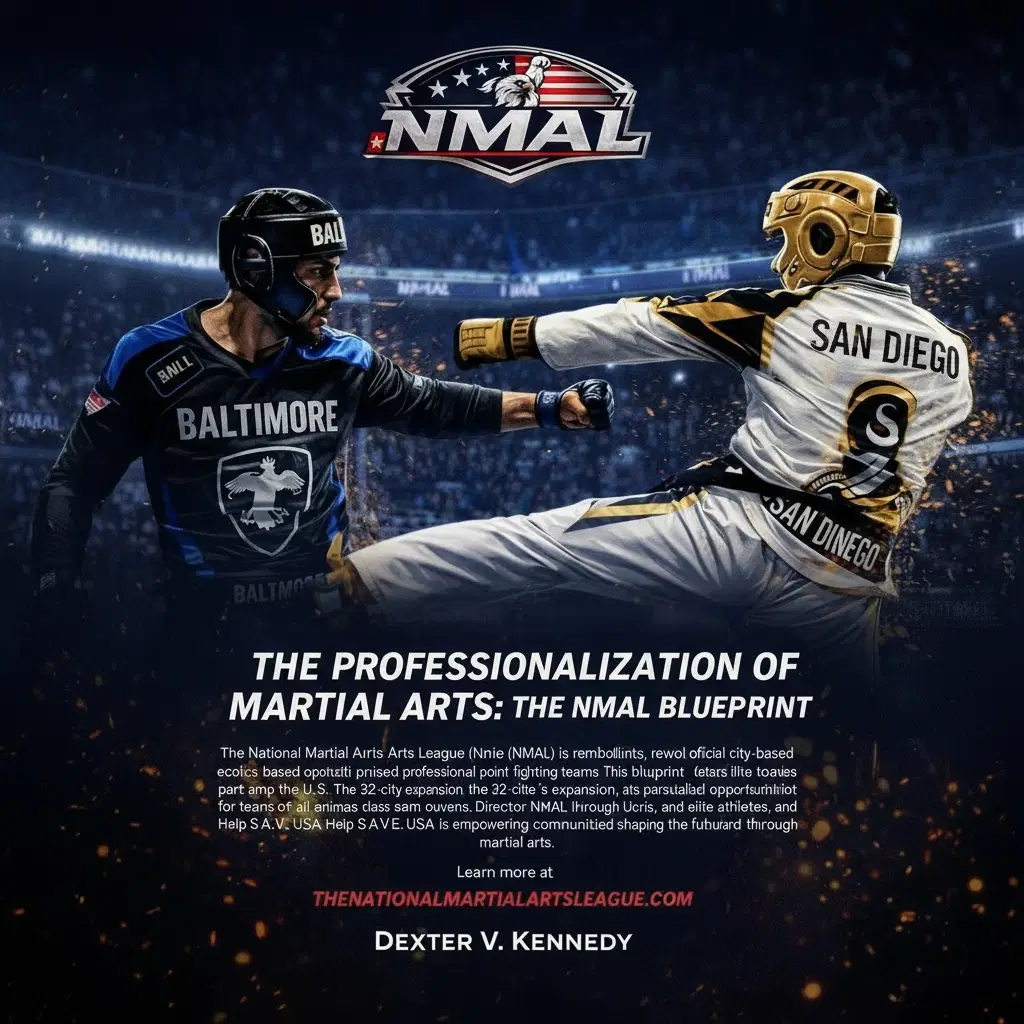
When you give a city a team to call their own, you create a built-in audience. A parent in Baltimore might not follow martial arts generally, but they will take their family to see the "Baltimore" team take on "San Diego." This localization is the key to moving martial arts from a niche hobby to a mainstream professional sport. It creates a community around the team that transcends the walls of any individual dojo.
4. Professional Branding is the New Standard
In the past, martial arts marketing was often fragmented and amateurish. The next phase of combat sports business demands a higher level of professionalization. This means high-quality production, unified rules, and consistent branding across the league.
As outlined in Dexter V. Kennedy’s Team Point Fighting Investors Game Plan, the visual and professional identity of the league is what attracts major sponsors and investors. We are seeing a move toward advanced, full-body protective gear that looks like it belongs in a high-budget sci-fi film, designed not just for safety, but for "televisibility."

For the business owner, this professionalization means lower risk and higher prestige. You are part of a league that has a standardized "look and feel," making it easier to sell to corporate partners who are hesitant to associate with the "underground" image sometimes associated with combat sports.
5. You Need a Proven Blueprint
Success in a new market requires more than just enthusiasm; it requires a roadmap. This is where the work of Dexter V. Kennedy becomes invaluable. As a 5th Degree Black Belt and a retired U.S. Army Warrant Officer, Kennedy has spent nearly two decades refining the business logic behind the NMAL.
His role as a visionary in this space is to provide the bridge between the traditional martial arts world and the high-stakes world of professional sports ownership. Through his books and consulting, he offers the "Investor’s Game Plan": a detailed look at how to structure a team, manage athletes, and generate a return on investment in this emerging field.

Kennedy’s vision isn’t just about sports; it’s about "Making People Better For Life." By creating a professional league, he is providing a career path for athletes and a positive, disciplined entertainment option for families. For an entrepreneur, this is an opportunity to build a legacy while building a business.
The Next Move is Yours
The professionalization of martial arts is not a matter of "if," but "when." The infrastructure is being built, the "Blue Ocean" is waiting, and the blueprint is already written.
If you are an entrepreneur, investor, or business leader looking for a venture that offers high growth potential and the chance to lead an industry-wide transformation, now is the time to explore the work of Dexter V. Kennedy.
Whether you are interested in team ownership, sports media, or innovative consulting, the resources available at dextervkennedy.com provide the foundation you need to make your next big business move.
Ready to explore the future of the National Martial Arts League?
- Read the Strategy: Pick up Pro Teams KumiteSport to understand the team-based vision.
- Get the Plan: Check out the Team Point Fighting Investors Game Plan for a deep dive into the business mechanics.
- Connect: Visit dextervkennedy.com to learn about consulting opportunities and how you can get involved in the next evolution of professional combat sports.


