
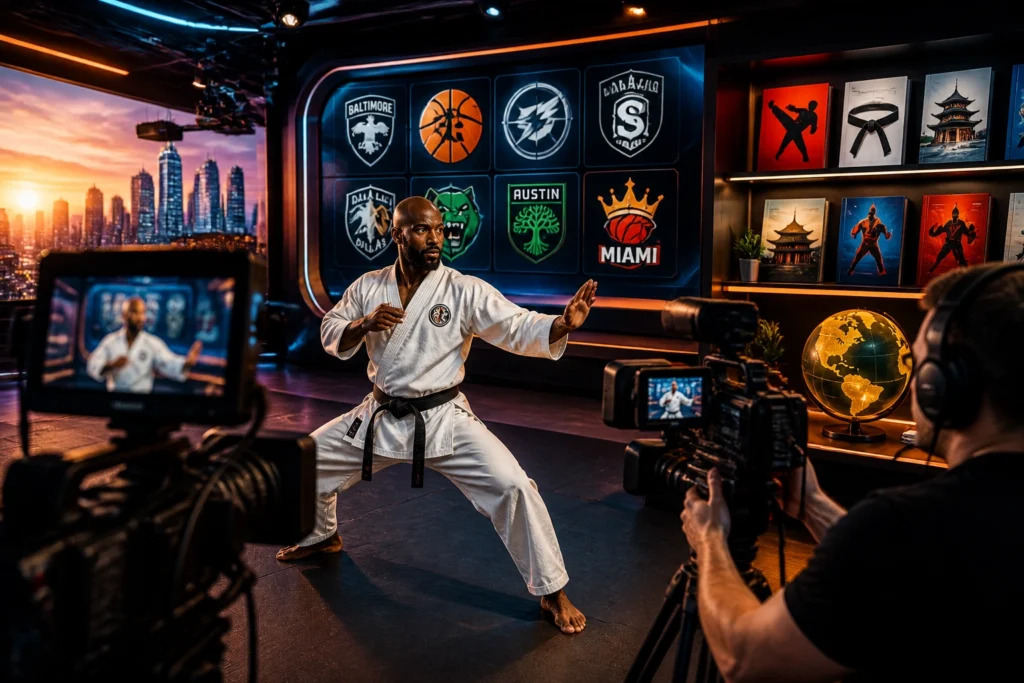
For decades, the path of the martial arts entrepreneur was predictable. You’d spend years honing your craft, earn your black belt, open a modest dojang in a local strip mall, and spend your evenings teaching students how to throw a proper reverse punch. Success was measured by the number of active memberships and the size of your square footage.
But there’s a ceiling to that model. You only have so many hours in the day, and your school only has so many mats.
The most successful innovators in the industry today: led by visionaries like Dexter V. Kennedy: are breaking through that ceiling. They’ve realized that the future of martial arts isn’t just in the teaching; it’s in the story, the media, and the platform. To scale your vision in the 21st century, you have to move beyond the physical walls of the dojang and into the digital and publishing world.
The Media Shift: From Instructor to Influencer
The traditional martial arts instructor is a local figure. The modern martial arts entrepreneur is a media entity.
When you leverage media: whether through video, podcasts, or digital content: you are no longer limited by your zip code. You are building an audience, and in the modern economy, attention is the ultimate currency. Scaling your business through media means you aren't just selling a 4:00 PM class; you are selling an idea, a lifestyle, and a brand.
Digital expansion allows you to offer on-demand training and recorded content that generates passive income while you sleep. But more importantly, it builds authority. When a prospective student or investor looks you up, they shouldn't just see a phone number and an address. They should see a content ecosystem that proves you are a leader in the field.
Publishing: The Ultimate Business Card
If social media is your daily conversation with the world, publishing a book is your formal manifesto. In the professional services world, a book is more than just words on a page: it is the ultimate business card.

Take a page out of the Dexter V. Kennedy playbook. Dexter didn't just stop at running a business; he documented his vision for the future of the sport. His books, such as Pro Teams KumiteSport and Team Point Fighting: In a Professional Martial Arts League, serve as the blueprint for an entire industry shift.
When you publish, you transition from being "the person who teaches karate" to "the person who wrote the book on martial arts innovation." This shift in perception is what opens doors to partnerships, speaking engagements, and high-level consulting. For any martial arts entrepreneur looking to scale, putting your methodology and vision into a published format is non-negotiable.
The League Revolution: Scaling the Platform
One of the most exciting frontiers in martial arts entrepreneurship is the move toward city-based professional leagues. This is where the concept of "scaling" reaches its peak. Instead of one school, imagine a franchise system modeled after the NFL or NBA, where city-based teams compete on a national stage.

The National Martial Arts League (NMAL) and Pro Teams KumiteSport (PTKMA) represent this next evolution. By professionalizing point martial arts, entrepreneurs have the opportunity to move into team ownership and league leadership. This isn't just about local competition; it’s about creating a televised, marketable product that captures the public imagination.
Dexter V. Kennedy’s work in Taking on the NFL: The National Martial Arts League outlines exactly how this model works. It transitions the sport from a hobbyist activity to a professional entertainment industry. For the entrepreneur, this means moving from managing a small team of instructors to managing a professional sports franchise.
Building Your Personal Brand
To lead a league or scale a media empire, the "man or woman in the middle" matters. People buy into people before they buy into products. Building a personal brand that reflects leadership, professionalism, and vision is essential.

Your personal brand should be the face of your innovation. Are you a disruptor? A traditionalist bringing old-school values to the modern world? A sports tech enthusiast? Whatever your angle, your media presence should reflect it consistently.
Dexter Kennedy has spent years building a brand centered on professionalizing the martial arts experience. His induction into the United States Martial Arts Hall of Fame and his background as a retired U.S. Army Warrant Officer provide a foundation of credibility that supports every book he writes and every league he founds. As an entrepreneur, you must identify your "unique value proposition" and broadcast it through every channel available.
Innovation in Branding: The "Slugging" Look
Scaling also requires a visual evolution. If you want to take on major professional sports, you have to look the part. Professionalizing martial arts media means moving away from the "generic dojo" aesthetic and toward high-impact, professional branding.

Notice how the branding for the 7 Clans of Kung Fu or the various NMAL teams uses team colors, professional logos, and advanced protective gear. This "pro-look" is what makes the sport palatable for mainstream media, sponsors, and investors. When your media reflects this level of professionalism, you attract a different caliber of partner.
Action Steps for the Martial Arts Entrepreneur
So, how do you actually start scaling your vision beyond the dojang? Here is a practical roadmap:
- Define Your Manifesto: What do you believe about the future of martial arts? Write it down. This is the seed for your first book or media series.
- Audit Your Content: Look at your social media. Is it just pictures of students with their yellow belts, or are you sharing thought-leadership content that discusses the industry's growth?
- Explore the League Model: Research how city-based professional leagues like the NMAL are structured. Could your school be the training ground for a future franchise? Check out the Team Point Fighting Investors Game Plan to see how the business side of professional leagues works.
- Invest in Production: You don't need a Hollywood studio, but you do need professional lighting, clear audio, and high-quality graphics. Your media quality is a direct reflection of your business standards.
- Connect with Visionaries: Don't reinvent the wheel. Study those who are already doing it. Explore the books and resources available at DexterVKennedy.com to see the blueprint for innovation in action.
Conclusion: The Future is Yours to Write
The martial arts industry is at a crossroads. We can continue to operate in silos, competing for the same few students in our local neighborhoods, or we can embrace the power of media and publishing to build something much larger.
The future of martial arts is professional, it is city-based, and it is media-driven. By leveraging the strategies of storytelling, authority-building, and professional league structures, you can scale your vision far beyond the four walls of your dojang.
Are you ready to stop just teaching and start leading? The blueprint is already written: now it's time for you to take the lead.
To dive deeper into the world of professional martial arts leagues and innovation, visit DexterVKennedy.com and explore the full collection of books that are shaping the future of the sport.


