
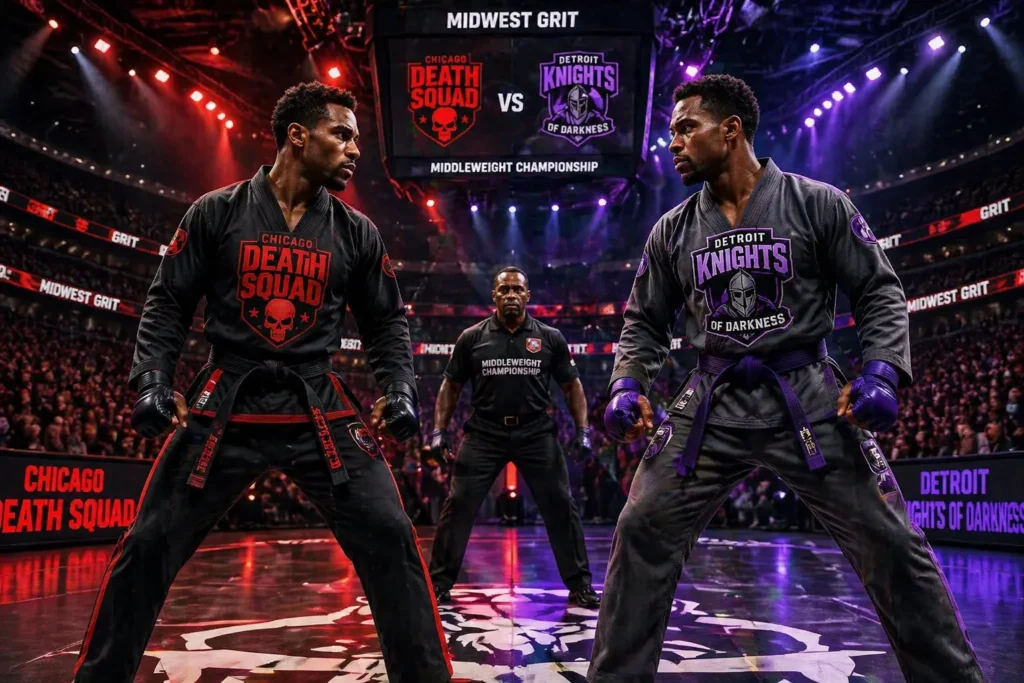
There is a specific kind of energy you only find in the Midwest. It’s a combination of hard-work ethics, a "no-quit" attitude, and a deep-seated love for hometown rivalries. When you take that spirit and inject it into the high-stakes world of the National Martial Arts League (NMAL), you get something explosive.
Specifically, when the Chicago Death Squad and the Detroit Knights of Darkness step onto the mat, the atmosphere shifts. This isn't just about individual glory anymore; it’s about city pride, tactical brilliance, and the evolution of the martial arts business.
In this post, we’re going behind the scenes of a typical NMAL event night, exploring the professional structure that is currently reshaping martial arts industry trends, and seeing why these two Midwest powerhouses are the ones to watch this season.
The Spectacle: More Than Just a Fight
When you walk into an NMAL arena, the first thing you notice is that it feels like a major league sports event. The days of dimly lit high school gyms are over. We’re talking about professional lighting, massive LED screens, and a production value that rivals the NFL or NBA.
Every event kicks off with a level of prestige that sets the tone for the night. The lights dim, the crowd goes silent, and the Star-Spangled Banner echoes through the rafters. This isn't just tradition; it’s a statement that martial arts has arrived on the big stage.
Following the anthem, the team introductions begin. The Chicago Death Squad emerges in their signature sleek black and red gear, followed by the Detroit Knights of Darkness in their charcoal and dark purple uniforms. The introduction of the judges and referees follows, top-tier professionals who ensure the integrity of the league’s rigorous points system. For the fans in the stands, a quick explanation of the rules is broadcast on the big screens, ensuring that everyone, from the lifelong black belt to the first-time spectator, knows exactly how the "Road to the Championship" is paved.
The Technical Edge: Starting with the "Logo Katas"
One of the most unique aspects of the NMAL format is how the scoring actually begins. Before a single punch is thrown in combat, the teams compete in Themed Martial Forms/Katas.

Each team selects their top technical artists to perform a kata that incorporates the team’s martial arts logo and identity. It is a breathtaking display of synchronization, power, and artistic precision. But make no mistake: this isn't just a performance. It is a strategic battle for points.
The order of performance is determined by a coin flip, and judges score these forms based on execution, difficulty, and how well they represent the team’s "brand." If the Chicago Death Squad nails their signature "Death Strike" sequence, they start the night with a points advantage that the Detroit Knights of Darkness will have to fight tooth and nail to overcome in the later rounds. This integration of traditional forms into a professional sports format is a key driver in current martial arts industry trends, bridging the gap between traditional discipline and modern entertainment.
The Power of the Roster: 13 Warriors, One Goal
Building a professional martial arts team is a complex puzzle. It requires more than just finding the "best fighter." It requires balance, depth, and a commitment to the team-first philosophy.
In the NMAL, each team carries a roster of 13 active fighters:
- 8 Male Fighters
- 5 Female Fighters

These athletes are spread across specific weight classes, ensuring that the competition is fair, fast, and incredibly technical. For the Detroit Knights of Darkness, their strength often lies in their mid-heavyweight men, known for a "grind-it-out" style that mirrors Detroit’s blue-collar history. Meanwhile, the Chicago Death Squad has built a reputation on their female roster, a group of five world-class strikers who are widely considered the most tactical unit in the league.
This roster depth is a central theme in Dexter V. Kennedy’s book, Team Point Fighting: Investors Game Plan. For school owners and sports entrepreneurs, understanding how to manage a diverse team of athletes is the secret to long-term success in the martial arts business.
The Main Event: Three Rounds of Precision
Once the katas are finished and the rosters are set, the actual combat begins. This is where "Midwest Grit" truly shines inside Professional Point Martial Arts.
Each match consists of three, three-minute rounds. If you’ve ever sparred for three minutes at a professional pace, you know that it feels like an eternity. Now imagine doing that under the lights of a sold-out arena with a city’s reputation on your shoulders.

The NMAL uses a sophisticated points-based system built around the discipline of technical striking and point-sparring excellence. It’s not about wild exchanges or reckless power shots. It’s about timing, distance, control, and the ability to score cleanly under pressure. At the end of the night, the team with the most points across all matches is declared the winner.
This format creates a unique dynamic. You’ll see the Chicago Death Squad bench screaming instructions to their fighter in the final ten seconds of a round, not just to survive, but to create the angle, manage the space, and land that one clean point that could swing the entire night’s scoreboard. That’s what makes Professional Point Martial Arts so compelling: every movement matters, every decision carries weight, and every exchange rewards discipline over chaos.
Why the Midwest is Leading the Charge
Why are Chicago and Detroit such hotbeds for this new era of martial arts? It comes down to the culture of the martial arts business in these regions. But now, the bigger story is that the entire Central region is starting to look like a real powerhouse in the league.
Chicago has long been a hub for innovative training methods and elite-level competition. In the context of Professional Point Martial Arts, that shows up in sharp footwork, disciplined technical striking, and a competitive mindset built on earning points with precision. The "Death Squad" isn't just a scary name; it represents a collective of schools that have put aside their differences to build a professional powerhouse. They are the gold standard for how to scale a local martial arts brand into a regional titan.
Detroit, on the other hand, brings a level of resilience that is unmatched. The "Knights of Darkness" reflect the Midwest mentality in a different way: tough, composed, and committed to point-sparring excellence even when the pace gets intense. Their events aren't just fights; they are city-wide celebrations. They’ve mastered the art of local sponsorship and fan engagement: key components discussed in Taking on the NFL: The National Martial Arts League.
And that Central-region momentum doesn’t stop with Chicago and Detroit. Cincinnati’s Thirty-Six Families bring a strong identity rooted in unity, structure, and team chemistry. Cleveland’s 108 Locking Hands add another layer to the region’s reputation, signaling a city that values discipline, coordination, and technical execution. Columbus enters the picture with the 9 Dragons, a name that instantly gives the city a bold, competitive presence in the NMAL conversation.
Taken together, these teams make it clear that the Central region is becoming one of the most important areas in the league. It’s not just producing tough athletes. It’s producing recognizable city brands, deeper talent pools, and the kind of regional rivalry that can help drive the future of Professional Point Martial Arts. What used to feel like a two-city story now feels like a much bigger movement across the middle of the country.
Investing in the Future of the Game
As we look at the trajectory of the NMAL, it’s clear that the "city-based" model is the future. It provides fans with a reason to care, athletes with a professional career path, and investors with a scalable business model.
If you’re a martial arts school owner, instructor, or sports entrepreneur, now is the time to pay attention. The industry is moving away from the "lone wolf" tournament style and toward the team-based, professional league format.
How You Can Get Involved:
- Educate Yourself: The blueprints for this revolution are already written. Visit our Book Library to explore the strategies behind team ownership, league marketing, and martial arts innovation.
- Think Local: Look at the Chicago and Detroit models. How can you collaborate with other schools in your area to build a regional brand?
- Follow the Trends: Stay updated on the NMAL season. Whether you’re rooting for the Red Lotus Clan or the Black Cobras, the lessons learned on the mat are applicable to every facet of the martial arts business.
The Midwest has shown us that with enough grit, tradition, and a professional mindset, martial arts can take center stage. The question is: which city will rise next?
Want to dive deeper into the vision behind the NMAL? Check out the full collection of Dexter V. Kennedy’s insights on the future of professional sports at DexterVKennedy.com.


